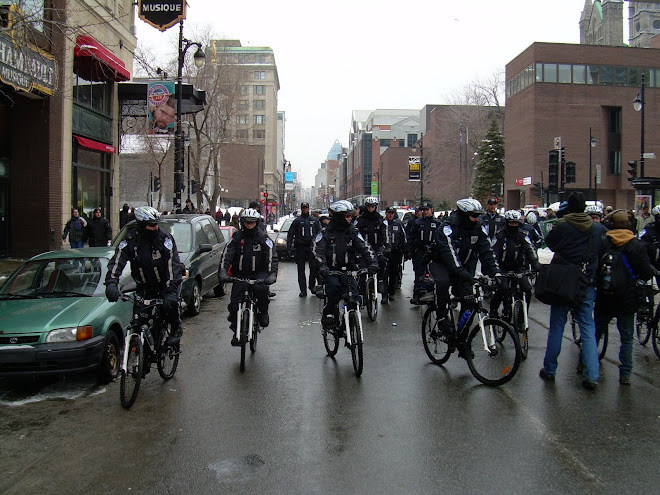
The news does keep rolling in from Greece, via various sources and connections. One recent piece from libcom.org is similar to a lot of anarchist/radical-left coverage in that it lists a great variety of activity in Greece (cast as part of a 'social antagonist movement'), including pensioners marching in protest of their nest-eggs evaporating and a demo targeting Athens' mayor as a "mass-murderer of trees' for his involvement with projects that have redeveloped urban green spaces. Also noted is a string of firebomb attacks on Orthodox churches, also noted in a Social War in Greece post (which re-disseminates an AP article) and, the 'lead' - results of a closed-door security meeting, the announcement of:
"the introduction of 1.300 cameras in the capital, the training of a special forces corps of 2.500 ex-underwater destruction and mountain combat units of the Army, to change the legislation concerning academic asylum, to implement severe measures against mask and hood wearing, and to launch a law and order campaign against crime and indiscipline. The issue was the topic of a day-long Parliamentary session two days later, where the government was heckled by the opposition as parochial and a danger to civil rights. The Fascist Party (LAOS) expressed its content stating that the PM speech was in effect a bricolage of its own communiqués of the last few months."
The poster of the original Libcom.org piece appears to be rather prolific in updating interested English-language online types - and provides a great deal of background and commentary. Clearly, a definite familiarity with Greek history, and almost certainly the Greek language, makes it possible to make the kind of detailed posts I often see on Libcom (which in turn parallels some of the other more interesting sources that have been posting on this context, such as the On the Greek Riots blog and the now-inactive Tapes Gone Loose blog).
The relative expertise and raw labour (in researching and writing a large number of detailed english-language updates w/commentary and background) of this particular poster has not gone unrecognized elsewhere - note this post from the .urbandissent blog on the torching of the neo-fascist Golden Dawn headquarters a month ago, which acknowledges this gift (while also noting some reservations about the poster's stance on guerilla violence). More an more, as I get a feel for what's out there on the 'anarchist web' and nearby concerning the Greek unrest and the situation there at present, this point (and the one made by .urbandissent) continues to jump out. Particularly after the initial wave of street actions, the most interesting and informative content tends to be produced by a very small number of individuals with a relatively high level of knowledge and commitment. Indeed, this is also somthing I've noticed on at least one major anarchist message board, where the major body of information being conveyed came from one Greek ex-pat in an English-speaking country who gave rich historic and contemporary detail of the political situation and supplemented this with personal experience (at points, some threads looked like question-and-answer sessions). This may seem like an obvious point in some ways (that a few dedicated and knowledgeable individuals keep things going and keep the rest in the loopl), but it does stress a certain tension with the 'early' Greek story of 'snap mobs' and 'many-to-many' communication...
Showing posts with label Greek unrest. Show all posts
Showing posts with label Greek unrest. Show all posts
Friday, April 10, 2009

Sunday, March 29, 2009
do facts matter?
Here's an interesting dissonance of perspectives that might highlight one of the most basic differences between (at least some) 'anarchist' perspectives and those commentators who have more faith in 'liberal democracy' - and I think this ties into the discussion of postmodern anarchism below, but might also bring up seriously problematic issues of justification and standards for truth...
Andrew Liam, quoted on the Gauravonomics blog:
"As witnessed in Greece, the failure to verify information by the public and media professionals can be tragic. There was a universal assumption in Greece that the teenager was shot in cold blood, and no one bothered to wait for the coroner’s report. The policeman’s claim that he was innocent – that he had shot into the air to disperse the crowd– was summarily dismissed. It is a dangerous world, indeed, when citizen reporters are completely trusted, both by the media institutions that incorporate them and by the audience who consume that information. The role of the mature news organization, one should think, is to filter real news from pseudo news, rather than treating all content as equal."
One American 'post-left' anarchist blog, CSA, suggested the following, by contrast, in a discussion of an early-January shooting of a Greek riot police officer that had provoked some 'conspiracy theories' at the time:
"Of course, the precise identities and motivations of the shooters is no more important in this case than in the shooting of Alexis Grigoropoulos [ed note: the teen shot by Greek police, provoking the first wave of demos and rioting in early December, referred to above]. Hopefully Greek anarchists will avoid being sucked into the melodrama of bourgeois justice and will continue building on their impressive gains of the last month."
I think the contrast is particularly interesting in that it does an end-run around the need for the kind of refutation of the former comment which is actually juxtaposed to it on the Gauvaronomics blog (from Katrin Verclas, claiming that there was no shortage of 'professional' information provision and publicised debate), and gets at something much bigger; certainly - if facts don't matter - it takes the fight to the arena of simulation or the spectacle...
It's worth keeping in mind that this (CSA) is a US site, and only one example, but other statements that link up an almost holistic, but rather poetic, world-picture of injustice perpetuated by a vision of authority and capitalist/consumer culture do seem to play into the 'postmodern' anarchist radicalism Call (2003) describes...
...and this could well be a troubling thing, in some ways.
As Patrick Meier suggests on his blog:
"The mainstream media has an increasingly important social service to play in the Twitter age: distinguishing fact from fiction"
...and he goes on to suggest (a key point, I think) that the initial riots need to be understood in context (what is it about Greece in particular?), though the first wave of information going viral, as that term suggests, may indeed be understood via a kind of 'contagion' model.
It is also worth noting that while initial forensics on the December 6 shooting scene indicated a ricochet (potentially corroborating the officers story that he fired a warning shot in the air), it was later reported - after Meier's and Liam's initial postings - that the ricochet was near ground level, and indicated that the officer shot at the youths, killing Alexis. Incidentally, even BEFORE the story told about inaccurate online info-sharing that jumped the gun on the coroner's report as the catalyst for the initial riots, there was a video and eye-witness testimony to the account eventually borne out by later forensics.
And in the 'context' connection, I think that the fact that things are still going on - if less intensely, in some ways - around the kinds of social struggle called out by anarchists and others in December certainly indicates that the CSA position that the detailed facts of a single incident may not be the heart of the bigger story continues to carry some weight contra the alarm of those focusing on what turned out to be an erroneous claim that the officer was not at least partially (or indeed, entirely) culpable in this case...
Subscribe to:
Posts (Atom)