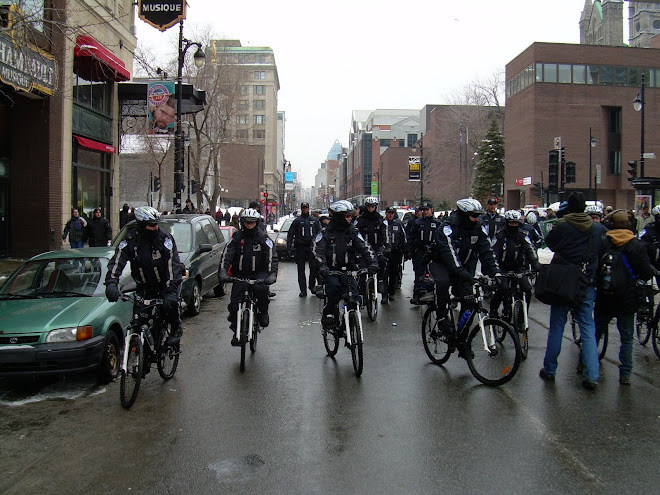
Here's an interesting dissonance of perspectives that might highlight one of the most basic differences between (at least some) 'anarchist' perspectives and those commentators who have more faith in 'liberal democracy' - and I think this ties into the discussion of postmodern anarchism below, but might also bring up seriously problematic issues of justification and standards for truth...
Andrew Liam, quoted on the Gauravonomics blog:
"As witnessed in Greece, the failure to verify information by the public and media professionals can be tragic. There was a universal assumption in Greece that the teenager was shot in cold blood, and no one bothered to wait for the coroner’s report. The policeman’s claim that he was innocent – that he had shot into the air to disperse the crowd– was summarily dismissed. It is a dangerous world, indeed, when citizen reporters are completely trusted, both by the media institutions that incorporate them and by the audience who consume that information. The role of the mature news organization, one should think, is to filter real news from pseudo news, rather than treating all content as equal."
One American 'post-left' anarchist blog, CSA, suggested the following, by contrast, in a discussion of an early-January shooting of a Greek riot police officer that had provoked some 'conspiracy theories' at the time:
"Of course, the precise identities and motivations of the shooters is no more important in this case than in the shooting of Alexis Grigoropoulos [ed note: the teen shot by Greek police, provoking the first wave of demos and rioting in early December, referred to above]. Hopefully Greek anarchists will avoid being sucked into the melodrama of bourgeois justice and will continue building on their impressive gains of the last month."
I think the contrast is particularly interesting in that it does an end-run around the need for the kind of refutation of the former comment which is actually juxtaposed to it on the Gauvaronomics blog (from Katrin Verclas, claiming that there was no shortage of 'professional' information provision and publicised debate), and gets at something much bigger; certainly - if facts don't matter - it takes the fight to the arena of simulation or the spectacle...
It's worth keeping in mind that this (CSA) is a US site, and only one example, but other statements that link up an almost holistic, but rather poetic, world-picture of injustice perpetuated by a vision of authority and capitalist/consumer culture do seem to play into the 'postmodern' anarchist radicalism Call (2003) describes...
...and this could well be a troubling thing, in some ways.
As Patrick Meier suggests on his blog:
"The mainstream media has an increasingly important social service to play in the Twitter age: distinguishing fact from fiction"
...and he goes on to suggest (a key point, I think) that the initial riots need to be understood in context (what is it about Greece in particular?), though the first wave of information going viral, as that term suggests, may indeed be understood via a kind of 'contagion' model.
It is also worth noting that while initial forensics on the December 6 shooting scene indicated a ricochet (potentially corroborating the officers story that he fired a warning shot in the air), it was later reported - after Meier's and Liam's initial postings - that the ricochet was near ground level, and indicated that the officer shot at the youths, killing Alexis. Incidentally, even BEFORE the story told about inaccurate online info-sharing that jumped the gun on the coroner's report as the catalyst for the initial riots, there was a video and eye-witness testimony to the account eventually borne out by later forensics.
And in the 'context' connection, I think that the fact that things are still going on - if less intensely, in some ways - around the kinds of social struggle called out by anarchists and others in December certainly indicates that the CSA position that the detailed facts of a single incident may not be the heart of the bigger story continues to carry some weight contra the alarm of those focusing on what turned out to be an erroneous claim that the officer was not at least partially (or indeed, entirely) culpable in this case...
Sunday, March 29, 2009
do facts matter?

Saturday, March 28, 2009
Collective identity, contemporary & 'postmodern' anarchism, and neo-Situationism
I feel that I should put up this post now, as it will concern issues that have arisen as central to my discussion as it will appear in my presentation Monday. Essentially, it concerns my interest in describing the possibility of a 'collective identity' as constructed in the online anarchist presentations of the Greek uprisings - which necessarily entails both the on- and off-line constitution of shared ideas or orientations (perhaps a 'political culture') among contemporary anarchists. Taking 'collective identity' in the sense of Alberto Melucci (1989, 1996), conceptualised as forming part of the connection between individual subjectivities and collective action, manifested as a process by which social movement constituents come to exert some aggregate force - and which may emerge through forms of communicative or direct interaction, generating cognitive definitions (and eliciting emotional responses) related to social movement-linked interpretations and goals, potential ends and means, and conceptualizations of 'social movement' contexts - I need a broad frame of commonality...but , perhaps unsurprisingly, what is really of interest in my observations is what is different moreso than what is common. Of course, within the task of describing what is interesting about the axes of difference it is necessary to focus on particular themes or oppositions (in reality, often manifested as tensions between analytically distinguished poles that establish the axes of difference with which I wish to concern myself).
In order to describe difference among what I wish to conceptualize as an analytically cogent 'group', I need a broad basis for 'collective identity'; in my reading, I feel that I've found a serviceably broad base in Uri Gordon's (2007, 2008) conceptualization of the 'political culture' of contemporary anarchism - which constitutes a 'field' of 'collective identity' in very general terms, and which I can proceed to cut up according to my observations and interests.
Gordon (2007:29), who wrote an excellent piece for Ha'aretz on the Greek situation in January, suggests that contemporary anarchism is marked by three “conceptual clusters”:
(a) the construction of the concept of ‘domination’ and the active opposition to all its forms and systems,
(b) the ethos of direct action as a primary mode of political engagement, both destructive and constructive, and
(c) the open-ended, experimental approach to revolutionary visions and strategies, which endorses epistemological pluralism and is strongly grounded in present tense action.
The key concept of ‘domination’ for Gordon is best described as “a disvalue: what anarchists want to negate. The word in its anarchist decontestation serves as a generic concept for the various systematic features of society whereby groups and persons are controlled, coerced, exploited, humiliated, discriminated against, etc.—all of which dynamics anarchists seek to uncover, challenge and erode” (ibid:37-38).
Contemporary anarchism, by Gordon’s account, is a relatively new coalescence of previously distinct struggles, a development that he traces back to the New Left of the 1960s, but the full ‘fusion’ of which he dates to the late 1990s and the advent of the global movements against neoliberal globalization. Contemporary anarchism, in this conception, amounts to a ‘political culture’ corresponding to forms of organization and ideological orientation identified with the ‘keywords’ “anarchism, anti-authoritarianism and horizontalism” (ibid:32).
This obviously does not cover all bases (actually, I think it might obscure a bit the opposite pole to the one I am about to describe, a more traditional, modernist, class-struggle aspect of anarchism that rest in realism, the pseudo-scientific problem of decoding the meaning of given sets of conditions, etc.), but serves as a decent launch-pad, in its high generality, for a tracing of the axes of difference that jump out at me in what I've been looking at. The commonalities of much of the 'anarchist' content seem to fit well with this definition, and many of the interesting divergences and debates seem to hit on questions of how to deal with problems that can - at their most general - be framed in this kind of vision.
One of the particular axes of difference jumping out at me, and the concern of this blog post, is the notion that a number of sources (see, for example, the my post on the text reproduced on the On the Greek Riots blog regarding the recent occupation adjacent to the Athens Polytechnic, or some of the material translated in the Tapes Gone Loose blog prior to its passing) seem to exhibit an affinity for poetic language, an artistic bent, and a loose idiom which seeks to link all 'domination' and struggle while maintaining a creative and provisional flavor that seems bent on fighting on a plane very concerned with representation - that challenges the language of the quotidian, and which really emphasizes the aspect of the 'experimental approach' and 'epistemological pluralism' Gordon points to.
It seems to me - and this actually emerged in the data forcing me to account for recurring themes - that there really is a strong tendency consonant with what Lewis Call (2003) calls 'Postmodern Anarchism' ( also the title of the book). This vision of anarchism takes up Baudrillard's notion that Marxism "may be radical in its content, but certainly not in it's form, which retains the language of bourgeois political economy almost in its entirety" (6-7). The idea here is that the PoMo critique of PolEcon "must stand entirely outside that seemingly hegemonic system" (8). Calls 'postmodern anarchism' calls out a critique of the sign a la Baudrillard, and weaves it with the common threads of certain contemporary feminisms, socialisms, subaltern theories, and - of course - anarchisms, that seek to reverse the flows and configurations of the micropower-based social reproduction mechanisms of the larger and more apparent structures of formal power (and the undercurrents associated with them). Call evokes an 'anarchy of the subject' and and 'anarchy of becoming', in terms of self-overcoming as perpetual project, and suggests a more capillary offensive against 'power' (as domination).
Interestingly, a major field here is the 'net - as simultaneously hyper-commodified and site to "the most outrageous revolutionary declarations" (14). What is big here is a revolution in signification, in semiotics - the kind of decentered and perpetual subversive attempts one might link to May 1968 in France via the influence of the Situationist International. To again cite Baudrillard: "even signs must burn" (23).
"Today simulation has become a massive social and cultural fact; it is therefore in the realm of simulation that any meaningful political action must take place" (ibid.). This takes the form of a "powerfully anachistic neo-Situationist politics" (ibid.) - which I will try to demostrate as an effective characteriztion of an important pole to be described in the axes of difference which cut across the field of contemporary anarchism described by observation of the presentation of the Greek scenario in anarchis/radical-left online contexts...but that's for next post. I will mention, however, that I have noticed a lot of talk of 'spectacle' a la Guy Debord in some of the revolution-speak reproduced from Greece online. Now I have to read Society of the Spectacle!
In terms of theoretical backcup on this point, Richard JF Day ('Setting up shop in nullity: neo-situationism and the new protest aesthetic', 2007) similarly highlights the neo-Situationist aspect of much contemporary anarchist - and other radical-left - protest, and connects it with the notion of a resistance which refuses to petition 'power' (government, the formal political structures of authority) or simply try to topple existing structures and take the reins - but rather seeks to work around, outside of, and in the interstices of formal power operations and to refigure the subjective aspects of micropowers and thus subvert their 'objective' manifestations...Graham St-John backs 'em up, focusing on the 'carnivalesque', etc...
In order to describe difference among what I wish to conceptualize as an analytically cogent 'group', I need a broad basis for 'collective identity'; in my reading, I feel that I've found a serviceably broad base in Uri Gordon's (2007, 2008) conceptualization of the 'political culture' of contemporary anarchism - which constitutes a 'field' of 'collective identity' in very general terms, and which I can proceed to cut up according to my observations and interests.
Gordon (2007:29), who wrote an excellent piece for Ha'aretz on the Greek situation in January, suggests that contemporary anarchism is marked by three “conceptual clusters”:
(a) the construction of the concept of ‘domination’ and the active opposition to all its forms and systems,
(b) the ethos of direct action as a primary mode of political engagement, both destructive and constructive, and
(c) the open-ended, experimental approach to revolutionary visions and strategies, which endorses epistemological pluralism and is strongly grounded in present tense action.
The key concept of ‘domination’ for Gordon is best described as “a disvalue: what anarchists want to negate. The word in its anarchist decontestation serves as a generic concept for the various systematic features of society whereby groups and persons are controlled, coerced, exploited, humiliated, discriminated against, etc.—all of which dynamics anarchists seek to uncover, challenge and erode” (ibid:37-38).
Contemporary anarchism, by Gordon’s account, is a relatively new coalescence of previously distinct struggles, a development that he traces back to the New Left of the 1960s, but the full ‘fusion’ of which he dates to the late 1990s and the advent of the global movements against neoliberal globalization. Contemporary anarchism, in this conception, amounts to a ‘political culture’ corresponding to forms of organization and ideological orientation identified with the ‘keywords’ “anarchism, anti-authoritarianism and horizontalism” (ibid:32).
This obviously does not cover all bases (actually, I think it might obscure a bit the opposite pole to the one I am about to describe, a more traditional, modernist, class-struggle aspect of anarchism that rest in realism, the pseudo-scientific problem of decoding the meaning of given sets of conditions, etc.), but serves as a decent launch-pad, in its high generality, for a tracing of the axes of difference that jump out at me in what I've been looking at. The commonalities of much of the 'anarchist' content seem to fit well with this definition, and many of the interesting divergences and debates seem to hit on questions of how to deal with problems that can - at their most general - be framed in this kind of vision.
One of the particular axes of difference jumping out at me, and the concern of this blog post, is the notion that a number of sources (see, for example, the my post on the text reproduced on the On the Greek Riots blog regarding the recent occupation adjacent to the Athens Polytechnic, or some of the material translated in the Tapes Gone Loose blog prior to its passing) seem to exhibit an affinity for poetic language, an artistic bent, and a loose idiom which seeks to link all 'domination' and struggle while maintaining a creative and provisional flavor that seems bent on fighting on a plane very concerned with representation - that challenges the language of the quotidian, and which really emphasizes the aspect of the 'experimental approach' and 'epistemological pluralism' Gordon points to.
It seems to me - and this actually emerged in the data forcing me to account for recurring themes - that there really is a strong tendency consonant with what Lewis Call (2003) calls 'Postmodern Anarchism' ( also the title of the book). This vision of anarchism takes up Baudrillard's notion that Marxism "may be radical in its content, but certainly not in it's form, which retains the language of bourgeois political economy almost in its entirety" (6-7). The idea here is that the PoMo critique of PolEcon "must stand entirely outside that seemingly hegemonic system" (8). Calls 'postmodern anarchism' calls out a critique of the sign a la Baudrillard, and weaves it with the common threads of certain contemporary feminisms, socialisms, subaltern theories, and - of course - anarchisms, that seek to reverse the flows and configurations of the micropower-based social reproduction mechanisms of the larger and more apparent structures of formal power (and the undercurrents associated with them). Call evokes an 'anarchy of the subject' and and 'anarchy of becoming', in terms of self-overcoming as perpetual project, and suggests a more capillary offensive against 'power' (as domination).
Interestingly, a major field here is the 'net - as simultaneously hyper-commodified and site to "the most outrageous revolutionary declarations" (14). What is big here is a revolution in signification, in semiotics - the kind of decentered and perpetual subversive attempts one might link to May 1968 in France via the influence of the Situationist International. To again cite Baudrillard: "even signs must burn" (23).
"Today simulation has become a massive social and cultural fact; it is therefore in the realm of simulation that any meaningful political action must take place" (ibid.). This takes the form of a "powerfully anachistic neo-Situationist politics" (ibid.) - which I will try to demostrate as an effective characteriztion of an important pole to be described in the axes of difference which cut across the field of contemporary anarchism described by observation of the presentation of the Greek scenario in anarchis/radical-left online contexts...but that's for next post. I will mention, however, that I have noticed a lot of talk of 'spectacle' a la Guy Debord in some of the revolution-speak reproduced from Greece online. Now I have to read Society of the Spectacle!
In terms of theoretical backcup on this point, Richard JF Day ('Setting up shop in nullity: neo-situationism and the new protest aesthetic', 2007) similarly highlights the neo-Situationist aspect of much contemporary anarchist - and other radical-left - protest, and connects it with the notion of a resistance which refuses to petition 'power' (government, the formal political structures of authority) or simply try to topple existing structures and take the reins - but rather seeks to work around, outside of, and in the interstices of formal power operations and to refigure the subjective aspects of micropowers and thus subvert their 'objective' manifestations...Graham St-John backs 'em up, focusing on the 'carnivalesque', etc...
New article about recent events in Greece posted on Molly's blog:
http://mollymew.blogspot.com/2009/03/international-anarchist-movement-greece_27.html
I'll try to comment on this if I have the time, but do like to post new stuff (even if this function of blogging is not exactly that of posting project updates and more in-depth thoughts...)
http://mollymew.blogspot.com/2009/03/international-anarchist-movement-greece_27.html
I'll try to comment on this if I have the time, but do like to post new stuff (even if this function of blogging is not exactly that of posting project updates and more in-depth thoughts...)
radical theoretical/perspectival pluralism, in-group/out-group communication, links and mainstream amplification...
This post is about the idea of posting links without making links; that is about sites (such as some of the blogs, etc. om the Greek uprisings) linking to sites that might appear to have very different ideas, agendas, or types of content, without making any content on this or making apparent any hierarchy of preference or judgments of quality (except, presumably, by inclusion and possibly by ordering/placement) ... this links with my discussion of 'laterality' earlier, as well as with ideas of theoretical or perspectival pluralism (and its perceived limitations) and the notion - which I'm taking from Owens and Palmers 2003 article 'Making the News: anarchist counter-public relations on the web' - that anarchist/radical-left web presence raises a possible tension between in-group and out-group communication.
It has come to my attention, for example, that one radical-left blog which hosts one the most extensive collections of anarchist/radical-left links on the web (of which I am aware) contains a couple of deliberate exclusions - based on a theoretical/perspectival disagreement with some sites tendency to maintain a radical theoretical pluralism which includes a relatively significant amount of content linked to certain strands of 'anarchism' (after all, a loose term) like anarcho-primitivism, anti-civilization, post-leftism, and what I'm going to cal 'riot porn' direct-actionism. All of these strains tend to be antagonistic towards more broad-based and long-stading strains, such as the various forms of anarcho-communism, syndicalism or more general 'libertarian socialisms'.
There's a whole history here (going back to some major polemics in the 80s and 90s by Bob Black, John Zerzan, etc. and more recently manifested in a dispute between AK Press and 'Anarchy: a journal of desire armed' in which the latter was blacklisted - i.e. dropped from distribution - by the former powerful 'anarchist' publisher/distributor for printing a brutal polemic against AK in the form of a letter by the aforementioned Black). The journal's response (in this editorial) is perhaps a classic defense of radical theoretical pluralism, railing against 'sectarianism' in favor of, well, a sort of solidarity with anyone calling with some connection to anarchist ideas, no matter how acerbic, antagonistic, divergent, etc. This is the kind of view to which at least one major anarchist 'hub' site - which I myself visit for news and forum discussion - also seems to subscribe, and this is the more notable of the linking exclusions on the blog I mentioned in the previous paragraph. The blogger there holds that implicitly supporting these strains is unhelpfult, that they are actually counter to any possible anarchist political successes, and that they mobilize just plain bad ideas. This probably only notable in that it does seem to be the case with many sites that more or less strong forms of radical pluralism (in many cases link-inclusive of sites that present perspectives that fall quite far from the linking origin site) are notable, and no comment is offered...that is, they link without making links.
I think that this connects with the notion of 'laterality' I discussed in a past post a couple of weeks ago - in that this presentation of hypertextual possibilities reinforces the idea of radical theoretical/perspectival pluralism itself, as it often does not make strong differentiations or evaluations between multiple sources. Clearly, it would be possible to go into more depth here - I'm thinking of the relatively complex analysis of hypertextual links in the xxxxx (????) reading here - but I think this a bit beyond my scope right now. I also think that the dynamic here is similar to the way in which posters on many anarchist news sites, and many blogs (including some of those specifically covering the Greek uprisings) repost/amplify mainstream news coverage without offering commentary - even when coverage focuses on how violent and unreasonable the presumed comrades or sisters/brothers in solidarity of the reposting parties are. When selection in some contexts seems to be based on extremely broad categories of relevance (this is about Greek anarchists, or protests, etc.) and increasing information flows, but less so on discriminating (in either sense) selection of information - the question arises, as it does with radical theoretical/perspectival pluralism, of the possible tension between in-group and out-group communication.
By this I mean to refer to the fact that amplifying negative mainstream coverage seems an especially ineffective strategy for building support among anyone who might not already be considered an adherent to the ways of seeing the world that might be common to many anarchists/radical-left-thinking people. The assumption, as I alluded to in a past post, must be that the audience is likely to come to the kinds of conclusions that the poster would - e.g. that these are accounts of interesting events, and that the characterization of anarchists, or of protesters, etc. is not the best possible view. That is, the assumption is of an 'in-group' audience - that the site is there as a community of interest rather than a (counter) public-relations node. In terms of the issue of radical theoretical/perspectival pluralism, the same assumptions either prevail, or much broader ones - that we should suggest, say, critique and even slander anything and everything, and that this (I'm inferring, though I'm playing with other possible logics) is the case either due to an irreducible value of difference, an need for agonistic struggle, a more-or-less ideal vision of the public sphere, or a progressive process such as the dialectic...interestingly enough, this almost seems to imply a view that information and ideas speak - and work - for themselves. The epistemological and political implications of such an assumption (and how they might 'link' to networked flows of information) are something that I will address in future posts, and in my paper.
It has come to my attention, for example, that one radical-left blog which hosts one the most extensive collections of anarchist/radical-left links on the web (of which I am aware) contains a couple of deliberate exclusions - based on a theoretical/perspectival disagreement with some sites tendency to maintain a radical theoretical pluralism which includes a relatively significant amount of content linked to certain strands of 'anarchism' (after all, a loose term) like anarcho-primitivism, anti-civilization, post-leftism, and what I'm going to cal 'riot porn' direct-actionism. All of these strains tend to be antagonistic towards more broad-based and long-stading strains, such as the various forms of anarcho-communism, syndicalism or more general 'libertarian socialisms'.
There's a whole history here (going back to some major polemics in the 80s and 90s by Bob Black, John Zerzan, etc. and more recently manifested in a dispute between AK Press and 'Anarchy: a journal of desire armed' in which the latter was blacklisted - i.e. dropped from distribution - by the former powerful 'anarchist' publisher/distributor for printing a brutal polemic against AK in the form of a letter by the aforementioned Black). The journal's response (in this editorial) is perhaps a classic defense of radical theoretical pluralism, railing against 'sectarianism' in favor of, well, a sort of solidarity with anyone calling with some connection to anarchist ideas, no matter how acerbic, antagonistic, divergent, etc. This is the kind of view to which at least one major anarchist 'hub' site - which I myself visit for news and forum discussion - also seems to subscribe, and this is the more notable of the linking exclusions on the blog I mentioned in the previous paragraph. The blogger there holds that implicitly supporting these strains is unhelpfult, that they are actually counter to any possible anarchist political successes, and that they mobilize just plain bad ideas. This probably only notable in that it does seem to be the case with many sites that more or less strong forms of radical pluralism (in many cases link-inclusive of sites that present perspectives that fall quite far from the linking origin site) are notable, and no comment is offered...that is, they link without making links.
I think that this connects with the notion of 'laterality' I discussed in a past post a couple of weeks ago - in that this presentation of hypertextual possibilities reinforces the idea of radical theoretical/perspectival pluralism itself, as it often does not make strong differentiations or evaluations between multiple sources. Clearly, it would be possible to go into more depth here - I'm thinking of the relatively complex analysis of hypertextual links in the xxxxx (????) reading here - but I think this a bit beyond my scope right now. I also think that the dynamic here is similar to the way in which posters on many anarchist news sites, and many blogs (including some of those specifically covering the Greek uprisings) repost/amplify mainstream news coverage without offering commentary - even when coverage focuses on how violent and unreasonable the presumed comrades or sisters/brothers in solidarity of the reposting parties are. When selection in some contexts seems to be based on extremely broad categories of relevance (this is about Greek anarchists, or protests, etc.) and increasing information flows, but less so on discriminating (in either sense) selection of information - the question arises, as it does with radical theoretical/perspectival pluralism, of the possible tension between in-group and out-group communication.
By this I mean to refer to the fact that amplifying negative mainstream coverage seems an especially ineffective strategy for building support among anyone who might not already be considered an adherent to the ways of seeing the world that might be common to many anarchists/radical-left-thinking people. The assumption, as I alluded to in a past post, must be that the audience is likely to come to the kinds of conclusions that the poster would - e.g. that these are accounts of interesting events, and that the characterization of anarchists, or of protesters, etc. is not the best possible view. That is, the assumption is of an 'in-group' audience - that the site is there as a community of interest rather than a (counter) public-relations node. In terms of the issue of radical theoretical/perspectival pluralism, the same assumptions either prevail, or much broader ones - that we should suggest, say, critique and even slander anything and everything, and that this (I'm inferring, though I'm playing with other possible logics) is the case either due to an irreducible value of difference, an need for agonistic struggle, a more-or-less ideal vision of the public sphere, or a progressive process such as the dialectic...interestingly enough, this almost seems to imply a view that information and ideas speak - and work - for themselves. The epistemological and political implications of such an assumption (and how they might 'link' to networked flows of information) are something that I will address in future posts, and in my paper.
Friday, March 27, 2009
riot police v. firesfighters on the streets of Athens - protesting for full-time work - YouTube video (BBC footage, but minus commentary):
http://www.youtube.com/watch?v=w9KjySKEOK4
http://www.youtube.com/watch?v=w9KjySKEOK4
Thursday, March 26, 2009
On asking questions and the material fragility of server-based social spaces
Duck-in-duck-out: I got another response to my request for an online (email) interview with one of the bloggers! And can't say that I'm surprised that my responses have been connected with a couple of the blogs that I consider to have been posting some of the more thought-provoking and unique material - such as translations of local Greek messages and news that doesn't seem to register in the mainstresm. My questions were as follows:
1. What effect do you hope to have with the blog, posting updates and original material on the situation in Greece, especially now that a lot of the mainstream and underground coverage has lessened since December? How does online media make a difference in struggles like this?
2. What role do you see for those of us outside of Greece in keeping up with events there, and what can perhaps be learned from the situation there?
3. How do those of you working on the blog decide what to post there (given that there has to be quite a bit of news and info out there...though perhaps not so much that I can find in English that's current)?
...and I'm not quite prepared to forward my thoughts on the much-appreciated response. More later [repeat as mantra].
As a bit of an aside: rude awakening (followed by a joyful moment) in the past 10 days, as one of the major anarchist hub-site message boards on which I've been conversing shut down completely without notice for several days, then returned - but without the messages posted to many topics over the past six (8?) weeks! Technical infrastructure issues invade the social space of the online forum, eh? In my case, this meant all of my carefully considered posts, which I otherwise have no record of. I found a thread when it came back up which described a technical problem with servers and transferring data (don't really get the jargon), in which one poster noted this loss (with a little lament). A response to that post expressed surprise (this hadn't been noticed), and a subsequent suggested that it would be just too much work to resequence everything to get the contents of the gap back online. Yet, lo and behold, my last visit - to check the latest - yielded the full temporal span. A reminder of the fragile materiality of the persistent background of accumulated energy, thought and interaction that get put into these things...
1. What effect do you hope to have with the blog, posting updates and original material on the situation in Greece, especially now that a lot of the mainstream and underground coverage has lessened since December? How does online media make a difference in struggles like this?
2. What role do you see for those of us outside of Greece in keeping up with events there, and what can perhaps be learned from the situation there?
3. How do those of you working on the blog decide what to post there (given that there has to be quite a bit of news and info out there...though perhaps not so much that I can find in English that's current)?
...and I'm not quite prepared to forward my thoughts on the much-appreciated response. More later [repeat as mantra].
As a bit of an aside: rude awakening (followed by a joyful moment) in the past 10 days, as one of the major anarchist hub-site message boards on which I've been conversing shut down completely without notice for several days, then returned - but without the messages posted to many topics over the past six (8?) weeks! Technical infrastructure issues invade the social space of the online forum, eh? In my case, this meant all of my carefully considered posts, which I otherwise have no record of. I found a thread when it came back up which described a technical problem with servers and transferring data (don't really get the jargon), in which one poster noted this loss (with a little lament). A response to that post expressed surprise (this hadn't been noticed), and a subsequent suggested that it would be just too much work to resequence everything to get the contents of the gap back online. Yet, lo and behold, my last visit - to check the latest - yielded the full temporal span. A reminder of the fragile materiality of the persistent background of accumulated energy, thought and interaction that get put into these things...
Wednesday, March 25, 2009
Crunch Time!
Whew, so it would appear that time is winding down on this paper project; with my presentation on Monday and little over two weeks to the cutoff for blogging my work and getting down to screen-to-paper processing, there is so much I haven't put up here. I know that these posts are littered with the wreckage of empty promises for other, new and improved future posts - but this time I mean it! For now, I am just going to outline some of my activities of late as a sort of compendium I can refer back to when I finish the lecture I'm currently writing and actually get down to blogging each and every individually:
It clearly behoves me to try to trace out the networked paths and locations I've been circulating in, and some of my key observations...soon!
I've had a few interesting exchanges on major anarchist discussion forums over the last couple of months; generally on the slow side of asynchrony, given that I'm pretty focused on Greece and the situation there has seen a major slowdown since December...
I've also tried a number of avenues to get a bit of direct input from the bloggers I've looked at, including a couple more peripheral to the Greek news but who've put up interesting commentary on the subject. In general, I've found that many are impossible to contact, most that can be are unresponsive (literally, tout court), and a couple kind and quick-thinking types have graced me with some kind of reply: one ongoing and one pending (but promised)...and a number of emails floating in the ether.
I've got some serious reading on the go, with Jeffery Juris (and others) on 'networked social movements' and the web as public sphere, Uri Gordon, Francis Dupuis-Deri and David Graeber on contemporary anarchism in general, Geert Lovink and Michael Dartnell on tactical media, online insurgency and blogging, and a particularly welcome find in an Owens and Palmer (2003...then grad students at UNC Chapel Hill) piece on anarchist use of the net to reach out after the early anti/alter-globalization surge, which introduces the simple-enough but - I'm thinking now, anyhow - potentially productive idea of a tension in online activist circles between in-group and out-group communications (which I think links to wider issues as well...)
And I must check out that iRevolution bit recommended to me...
The Occupied London blog is still seeming somewhat regular (others less so, if at all), and putting up interesting material to keep things hopping...and various items of news and commentary seem to pop up intermittently, which keeps me close to my Blogger RSS, anarchist Twitterers and assorted alternative-anarchist-radical-left news sites when I can spare the screen-time...
Alas, back to lecture writing on social deviance, contestation, social movements and the anti-police brutality march this past 15th!
It clearly behoves me to try to trace out the networked paths and locations I've been circulating in, and some of my key observations...soon!
I've had a few interesting exchanges on major anarchist discussion forums over the last couple of months; generally on the slow side of asynchrony, given that I'm pretty focused on Greece and the situation there has seen a major slowdown since December...
I've also tried a number of avenues to get a bit of direct input from the bloggers I've looked at, including a couple more peripheral to the Greek news but who've put up interesting commentary on the subject. In general, I've found that many are impossible to contact, most that can be are unresponsive (literally, tout court), and a couple kind and quick-thinking types have graced me with some kind of reply: one ongoing and one pending (but promised)...and a number of emails floating in the ether.
I've got some serious reading on the go, with Jeffery Juris (and others) on 'networked social movements' and the web as public sphere, Uri Gordon, Francis Dupuis-Deri and David Graeber on contemporary anarchism in general, Geert Lovink and Michael Dartnell on tactical media, online insurgency and blogging, and a particularly welcome find in an Owens and Palmer (2003...then grad students at UNC Chapel Hill) piece on anarchist use of the net to reach out after the early anti/alter-globalization surge, which introduces the simple-enough but - I'm thinking now, anyhow - potentially productive idea of a tension in online activist circles between in-group and out-group communications (which I think links to wider issues as well...)
And I must check out that iRevolution bit recommended to me...
The Occupied London blog is still seeming somewhat regular (others less so, if at all), and putting up interesting material to keep things hopping...and various items of news and commentary seem to pop up intermittently, which keeps me close to my Blogger RSS, anarchist Twitterers and assorted alternative-anarchist-radical-left news sites when I can spare the screen-time...
Alas, back to lecture writing on social deviance, contestation, social movements and the anti-police brutality march this past 15th!
Subscribe to:
Posts (Atom)